
Bringing Forward the Bread and Wine
July 30, 2026 • Written by Vicki Klima
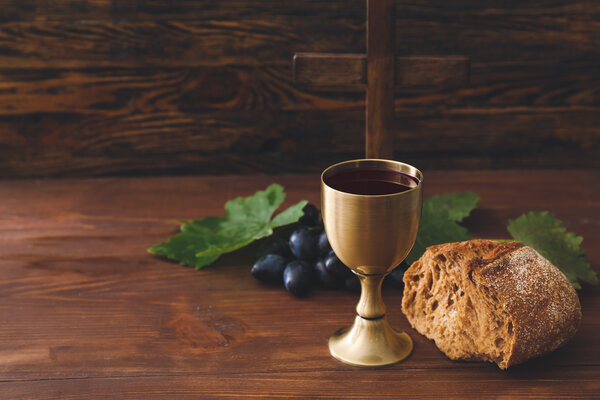
Another change after the Second Vatican Council was processing the bread and wine used at Mass to the altar. The Roman Missal states: “It is desirable that the faithful express their participation by making an offering, bringing forward bread and wine for the celebration of the Eucharist and perhaps other gifts to relieve the needs of the Church and of the poor.” #22
One of the misunderstandings some had took place at many school Masses. The phrase “and perhaps other gifts” received a wide interpretation by those in charge thinking of what things students would like to offer to God at this time. We could involve many students if lots of things were brought forward. Also, there would be a long list to be read that explained the significance of each item. Therefore, we brought forward textbooks, footballs and basketballs and other sporting equipment, chemistry glassware, Home Ec. projects, a globe, well, you get the idea.
The General Instruction of the Roman Missal clarified these “other gifts:” “Even money or other gifts for the poor or for the Church, brought by the faithful or collected in the church, are acceptable; given their purpose, they are to be put in a suitable place away from the Eucharistic table.” #73 So, we learned. I am sad to say though that many students remember these processions as meaningful expressions of what they wanted to offer to God. I am uncertain if the confusion has been clarified to this day.
The General Instruction #73 also states: “Even though the faithful no longer bring from their own possessions the bread and wine intended for the liturgy as was once the case, nevertheless the rite of carrying up the offerings still keeps its spiritual efficacy and significance.” I have written about that in my book, Participation of the Heart. Below is a summary of what I said.
Jesus chose bread at the Last Supper to become his body. Bread comes from the earth and the work of human hands. People do not pick wheat and eat grains off the stalk. Making bread is a long process that begins with preparing a field, planting seeds, nurturing the plants, and reaping the harvest. The wheat is taken through a process of separating it from the chaff and grinding it into flour. Other ingredients are added to the flour and then baked.
In olden times, the whole process would have been done by one family or clan. Later mills took over the grinding part of the process. Today, there could be different manufacturers in charge of each part including farming, milling, and transportation industries, bakeries and grocery chains. There are people involved in packaging, shipping, distributing, selling, and buying these products. We don’t have bread without highways, telephones, computers, mail service, accountants, secretaries, and more. We could make a similar list for wine. Do we think about any of this when we put a loaf of bread or bottle of wine into our cart at the store?
Consider all the people and systems represented when we take bread and wine and bring them forward at Mass. The whole social and economic organization of our society is symbolized in the bread and wine we bring to the altar. The human family is interconnected. We must rely on one another for goods and services that we need in life. Can we take it all for granted, or do we have a responsibility to make certain these industries act responsibly toward the earth and justly with business practices and employees? Bringing up the gifts may be a simple action, but understanding that action means understanding our relationship to our global family.
Psalm Refrain, 18th Sunday in Ordinary Time, Aug 2, 2026: The hand of the Lord feeds us; he answers all our needs. Psalm 145:6
Subscribe to Vicki Klima's Liturgy Blog!

Vicki Klima
Vicki, a retired liturgist and parish administrator, is passionate about enriching Catholic worship. She authored Participation of the Heart to help Catholics engage more deeply in the Mass. With a Master’s in Pastoral Liturgy, she has led workshops, written for liturgical publications, and continues to inspire through speaking, writing, and her love of music and theater.