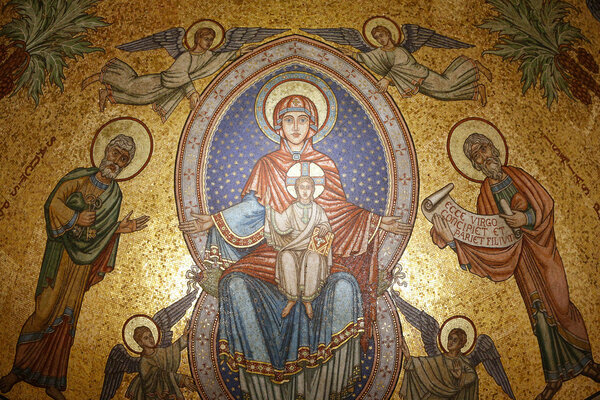
It seems that Mary, Mother of God is the oldest Marian liturgical commemoration in the Church’s history. Being chosen by God to be the mother of the Son of God is the origin of all other devotional practices and feast days to Mary. We celebrate her motherhood within days of the celebration of the incarnation. God becomes flesh through the “yes” of Mary. The Prayer after Communion also proclaims her “Mother of your Son and Mother of the Church.”
I don’t think many people in the United States who attend Mass on January 1 do so to honor Mary. New Year’s Day overshadows the liturgical day. People are praying in thanksgiving for the former year and for help in anticipation for the upcoming year. Christmas music works with the readings and the season, and so we could celebrate the entire Holy Day without much of a nod specifically to Mary.
I think these motifs can come together into a cohesive whole if we are intentional in doing so. Christmas and the motherhood of Mary fit together easily. Reminding ourselves to use Mary as a model to follow in the New Year adds the final piece.
I am struck that Mary reflects on all these things she has been told about her son in her heart (today’s gospel). She was living with the mystery allowing it to shape her vision and actions. I get frustrated living with the unknown and with things beyond my comprehension even though that’s a big component of faith. Mary can teach us about having faith in the midst of each day’s challenges.
This could be a good time to explore the phrase from the Nicene Creed, “by the Holy Spirit (Jesus) was incarnate of the Virgin Mary and, became man.” The word “incarnation” refers to God taking on flesh and becoming human. Mary plays a unique role in bringing Christ into this world. She is called “Theotokos,” which means “God-bearer” in Greek, a title that goes back to the third or fourth century Church and was defined at the Council of Ephesus in 431 A.D.
A heresy at the time had declared that Mary was only the mother of Jesus’ human nature. The Council declared that Jesus’ human and divine natures were united into one. Mary is the Mother of Jesus who is fully human and fully divine.
We honor Mary because of what she did in her life. She is our model for trusting in God. She trusted the angel and answered “Yes” to God. We try to imitate her faithfulness seen in the midst of the Scripture stories about her, including those that show her suffering as the mother of Jesus.
Reflection: Read the account of her “yes” in Luke 1:26 – 38. Then pray along with Mary the prayer called the Magnificat (“My Soul Magnifies the Lord” – The word “magnify” can mean to give praise) in Luke 1:46 – 55.