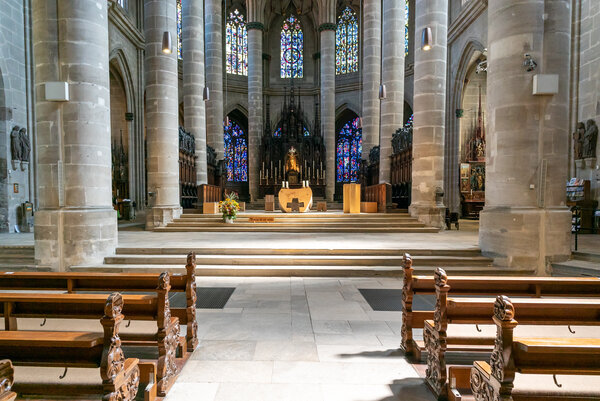
One of the more noticeable changes that came about after the Second Vatican Council was the moving of the altar and the placement of the priest at the altar for the Liturgy of the Eucharist. I can remember the altar against the wall and watching the priest’s back while he was praying at the altar. I could follow along with my St Joseph Missal, but I didn’t know exactly what he was praying. Besides his back to me, it was also in Latin. I found it refreshing to be to see what he was doing when the altar was removed from the wall and he stood facing us. Also, I could now understand what was said because the words were in English.
The history and development of altars is complex as is most everything in our liturgical past. The point I want to make today is that the altar of sacrifice is also the table of the Eucharistic Feast. Some people might see a conflict wondering which idea should have the greater emphasis. The Church tells us it is “both/and.”
“The altar, on which is effected the Sacrifice of the Cross made present under sacramental signs, is also the table of the Lord to which the People of God is convoked to participate in the Mass, and it is also the center of the thanksgiving that is accomplished through the Eucharist.” General Instruction of the Roman Missal #296
The document goes on to say: “The altar should be built separate from the wall, in such a way that it is possible to walk around it easily and that Mass can be celebrated at it facing the people, which is desirable wherever possible. Moreover, the altar should occupy a place where it is truly the center toward which the attention of the whole congregation of the faithful naturally turns.” GIRM #299
We can refer to our liturgy as the Holy Sacrifice of the Mass because we celebrate the Paschal Mystery of Christ’s life, death, resurrection and ascension in the Mass. Here is a paragraph to ponder: “At the Last Supper, on the night when He was betrayed, our Savior instituted the eucharistic sacrifice of His Body and Blood. He did this in order to perpetuate the sacrifice of the Cross throughout the centuries until He should come again, and so to entrust to His beloved spouse, the Church, a memorial of His death and resurrection: a sacrament of love, a sign of unity, a bond of charity, a paschal banquet in which Christ is eaten, the mind is filled with grace, and a pledge of future glory is given to us.” Constitution on the Sacred Liturgy #47
The altar is at the center of our worship as both place of sacrifice and meal. On the altar, the bread and wine become the broken Body and poured out Blood of Christ. We are invited to eat and drink and so become that Body and Blood, to be Christ in our daily encounters with one another, with strangers, with all of God’s creation.